
For component manufacturers
 For component manufacturers
Evaluate component structures in immersion.
Investigate how fluid health and component geometry relate to electrical behavior, using representative test structures in the immersion environments your customers use.
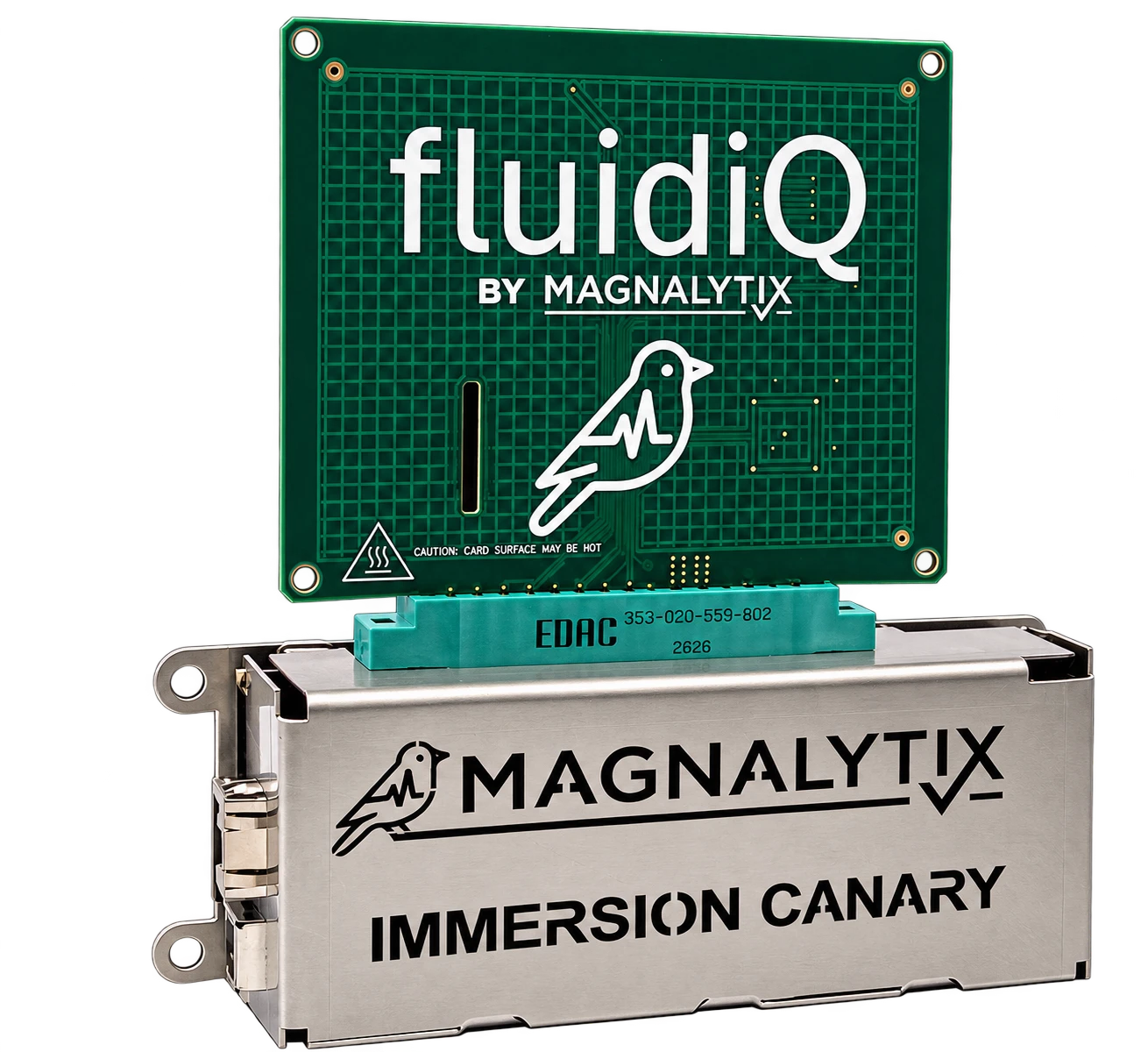
How Immersion Canary helps.
Compare electrical behavior across representative component geometries and use the results in qualification and quality investigations.
QFN, BGA, QFP, and power-choke test structures help you investigate Environmentally Induced Degradation (EID) across single-phase and two-phase environments.
Immersion Canary uses PCB-representative test structures to make that electronics-fluid interface visible over time.
Record measurements in your monitoring platform or Aviary to support qualification, quality, and warranty investigations with a timestamped history.
What it monitors
Surface resistance and fluid volume resistivity, measured continuously.
Fluid health, continuously
Surface resistance from 1 MΩ to 1 TΩ across PCB-representative test structures in your dielectric, under a bias you configure, alongside fluid volume resistivity from about 1.5 MΩ·cm to 1.5 TΩ·cm (about 15 kΩ·m to 15 GΩ·m).
Measured against your own baseline
Each tank sets its own baseline when it is commissioned and healthy. Live condition is reported against that baseline, so what you see is change in your environment rather than a generic threshold.
In real operating conditions
Independent heater control simulates the localized heating of high-power components on the test card. Heater duty cycle and test-card temperature are reported alongside the electrical measurement.
Into the systems you already run
A dashboard served by the instrument itself, plus HTTP/JSON REST, Redfish, Modbus/TCP and MQTT for your historian, DCIM, SCADA or alerting stack.
The work behind this
- PublishedIndustry collaboration
OCP Material Compatibility Workstream
Through its participation in the OCP Material Compatibility Workstream, fluidiQ by Magnalytix helped build and continues to help maintain the open-source Material Compatibility Database, covering wetted material compatibility across single-phase and two-phase dielectric fluid families.
Where our laboratory work applies to you.
Component & Material Testing
Test specific components and materials in a controlled immersion environment.
Material Compatibility
Evaluate how wetted materials interact with a dielectric fluid over time.
Custom Immersion Studies
Design and run a study against a question that does not fit a standard test plan.
Discuss component evaluation
Tell us what you are running and we will reply within one business day.

Find us on the show floor
Booth 3947
McCormick Place, Chicago. Exhibits November 17–19, 2026, Tue–Wed 10am–6pm · Thu 10am–3pm. Two live tanks running at the booth.
Open the show floor map